 listicle
Slow Travel for Retirees: Benefits Beyond the Bucket List
Table of Contents
- What Slow Travel Means for Retirees
- Health and Wellbeing Gains from Extended Stays
- Budgeting for Extended Travel in Retirement
- Building Genuine Connections Through Slow Travel
- Long-Term Travel Insurance for Retirees
- How to Plan a Slow Travel Trip
- Practical Logistics: Home, Health, and Flexibility
- Conclusion
Last Updated: August 16, 2026
What Slow Travel Means for Retirees
Slow travel for retirees isn't about moving at a leisurely pace, it's about fundamentally reframing what a retirement adventure looks like. Instead of cramming a dozen countries into two weeks, you're spending weeks or months in single destinations, absorbing the rhythm of a place rather than its highlights.
The shift from traditional tourism to slow travel changes everything. You're no longer checking boxes on an itinerary. You're learning the baker's name in your neighbourhood, understanding local customs without a guidebook, and discovering why people actually choose to live where you're visiting. This approach works particularly well for retirees because it aligns with what this stage of life offers: time.
Curious Compass Collective has built their entire model around this principle. Their thoughtfully paced itineraries and small-group structure mean you're not racing between sites. You're staying put long enough to develop genuine relationships with guides, locals, and fellow travellers. The difference between a rushed two-week tour and a month-long slow travel experience isn't just comfort, it's transformation.
Many retirees discover that slow travel for retirees solves a problem they didn't know they had: the exhaustion of traditional tourism. You avoid the travel burnout that comes from constant movement, endless logistics, and the pressure to see everything. Instead, you get restorative travel that actually restores you.
Health and Wellbeing Gains from Extended Stays
The physical benefits of extended stays are immediate and measurable. When you're not moving every two days, your body stops being in constant adjustment mode. Jet lag settles. Sleep normalises. The accumulated fatigue from perpetual packing and unpacking simply disappears.
But the deeper gains are psychological. Extended stays reduce travel anxiety dramatically. You know where the pharmacy is. You've figured out the local transport. You understand how things work in this place. That familiarity creates a sense of safety and control that rapid-fire tourism can never provide.
Mental health improvements come from rhythm and routine. A study of extended travel patterns shows that retirees who stay in one location for 4+ weeks report significantly lower stress levels than those who move weekly. You can establish a morning walk route. Join a local class. Sit in the same café and become a regular. These patterns, the things that make a place feel like home, are precisely what slow travel for retirees enables.
Cognitive engagement deepens too. Learning to navigate a new culture at a slower pace activates different parts of your brain than rushing through tourist attractions. You're learning language fragments, understanding local history, decoding social customs. This kind of active engagement is protective for cognitive health in ways that passive sightseeing isn't.
Physical activity naturally increases without pressure. You're walking to run errands. You're exploring neighbourhoods on foot. You're not exhausted, so you actually want to move. Many retirees find they're more active during slow travel months than they were at home.
Budgeting for Extended Travel in Retirement
Extended stays flip the economics of travel upside down. The longer you stay in one place, the lower your daily costs become. Hotels that charge premium nightly rates offer substantial discounts for monthly bookings. Restaurants where you become a regular often provide local pricing rather than tourist pricing. Transport costs amortise across weeks rather than days.
Budgeting for extended travel in retirement requires a different mental model than vacation planning. Instead of thinking "How much will two weeks cost?", you're thinking about sustainable monthly spend. Many retirees find that a month in a lower cost-of-living destination actually costs less than a month at home, once you factor in reduced utilities, no commute, and simplified daily expenses.
Long-term accommodation strategies matter significantly. Vacation rentals with weekly or monthly discounts become viable. House-sitting platforms like Aussie House Sitters (starting at $89 AUD per year membership) provide free accommodation in exchange for pet and home care. TrustedHousesitters offers similar opportunities globally for approximately $129-169 USD annually. These aren't budget compromises, they're lifestyle upgrades where you live in someone's actual home rather than a hotel room.
The geographic arbitrage principle works powerfully for retirees. A modest retirement income stretches dramatically further in destinations where the cost-of-living is substantially lower. Your fixed income becomes more flexible. You gain real purchasing power. This isn't about deprivation, it's about having more, not less.
Track spending differently during slow travel. Daily expenses matter less than monthly patterns. You'll notice seasonal variations in your spending, opportunities to reduce costs by moving slightly earlier or later in the season, and which destinations genuinely align with your budget versus which ones require constant financial vigilance.
Building Genuine Connections Through Slow Travel
This is where slow travel for retirees becomes something entirely different from tourism. Genuine connections emerge when you're present long enough for reciprocal relationships to form. You're not a visitor passing through. You're someone who will be here next week, and the week after that.
Local communities respond differently to people who stay. Shop owners learn your preferences. You become part of the neighbourhood rhythm. Guides who work with you repeatedly share deeper stories, not the sanitised tourist version. You meet other long-term travellers and develop friendships that extend beyond the tour.
Curious Compass Collective's expert guides function as cultural translators and storytellers, not just logistics coordinators. Their small-group model means you're developing relationships with the same people throughout your journey. You're not anonymous in a coach with 40 strangers. You're part of a genuine community, however temporary.
Cultural immersion accelerates dramatically when you stay put. You can attend local festivals, not just observe them. You can take classes in cooking, language, or crafts. You can volunteer in your community. These aren't activities scheduled into your itinerary, they're organic parts of living somewhere for an extended period.

Many retirees report that the relationships formed during slow travel become the most meaningful part of the experience. You're not collecting memories of landmarks. You're building actual friendships with people from different cultures and backgrounds.
Long-Term Travel Insurance for Retirees
Travel insurance becomes essential when you're away for months rather than weeks. Standard holiday insurance typically covers trips up to 90 days. Extended stays require different coverage entirely.
Providers like Freely Travel Insurance specialise in policies for seniors undertaking extended travel. Their coverage includes unlimited overseas medical and dental expenses (subject to conditions), automatic cover for many pre-existing medical conditions, and 24/7 emergency assistance. The critical feature for slow travel is that they understand you're not on holiday, you're living abroad temporarily.
Long-term travel insurance for retirees should cover:
- Emergency medical evacuation (essential in remote areas)
- Repatriation if you need to return home unexpectedly
- Pre-existing medical conditions (with proper declaration)
- Travel delays and cancellations
- Personal liability
- Dental emergencies
The cost structure differs from short-term insurance. Rather than paying per week, you're typically quoted for specific durations (three months, six months, annual). Premiums vary based on age, destination, trip duration, and declared medical conditions. National Seniors Travel offers packages specifically for members, often with competitive pricing and 24-hour travel assistance.
When selecting long-term travel insurance, be explicit about your plans. If you're staying in one location for six months, that's different from moving between multiple countries. If you have pre-existing conditions, declare them upfront, attempting to hide medical history invalidates coverage when you actually need it.
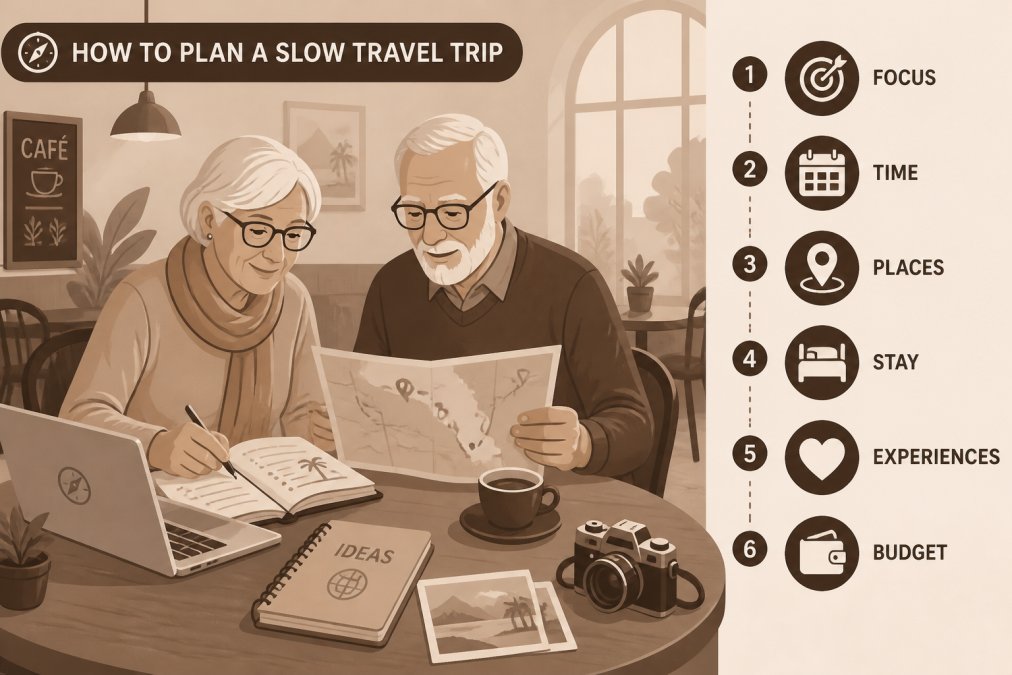
How to Plan a Slow Travel Trip
Planning slow travel for retirees requires a different approach than traditional itinerary building. You're not optimising for maximum destinations. You're optimising for sustainable pace and meaningful experience.
Start by identifying your anchor destinations, the places you'll spend 4+ weeks. These become your home bases. From each anchor, you might take shorter excursions to nearby areas, but you're returning to your home base regularly. This structure eliminates constant packing and provides stability.
Research cost-of-living in potential destinations. Wikicamps Australia (a one-off purchase) helps if you're planning extended Australian travel, showing caravan parks, camping grounds, and facilities across the country. For international destinations, online cost calculators and expat forums provide realistic monthly budgets.
Build flexibility into your timeline. Slow travel works best when you're not locked into rigid dates. If you arrive somewhere and love it, stay longer. If a destination isn't working, move on. This spontaneity is one of slow travel's greatest advantages. Your itinerary is a guide, not a prison.
Consider travel logistics carefully. How will you manage mail and bills? Will you need to maintain a home? How will you handle tax and residency implications? These aren't romantic questions, but they're essential. Many retirees maintain a small home base and travel from there, others rent out their property, and others simply embrace being geographically mobile.
Connect with communities before you arrive. Join online forums for expats in your target destinations. Follow local social media accounts. Learn basic phrases in the local language using tools like Duolingo (free, with optional premium subscription). This preparation transforms arrival from disorientation into genuine connection.
| Planning Element | Timeline | Key Consideration |
|---|---|---|
| Destination research | 2-3 months before | Cost-of-living, visa requirements, climate |
| Accommodation booking | 4-6 weeks before | Monthly discounts, house-sitting opportunities |
| Insurance arrangement | 6-8 weeks before | Pre-existing conditions, coverage duration |
| Logistics planning | 8-10 weeks before | Mail management, home care, tax implications |
| Language preparation | 3+ months before | Basic phrases, cultural context |
| Community connection | 2-4 weeks before | Online forums, local contacts, cultural events |
Practical Logistics: Home, Health, and Flexibility
Extended travel creates practical challenges that short holidays don't. Your home doesn't stop existing because you're away. Your health needs don't pause. Your financial obligations continue.
Home management options vary. Some retirees hire property managers to handle maintenance and rent out their property, generating income that offsets travel costs. Others use house-sitting platforms, where you live in someone's home while caring for their property and pets. Aussie House Sitters connects you with Australian-based house-sitting opportunities, while TrustedHousesitters offers global options. Some simply close up their home, arrange for a trusted friend to check on it periodically, and accept that it will sit empty.
Health management during extended travel requires preparation. Ensure your prescriptions can be filled internationally or that you have sufficient medication for your entire trip. Establish relationships with local healthcare providers in your destination, many retirees find that healthcare quality and cost vary dramatically by location. Research hospitals and clinics before arrival. Understand how your travel insurance claims process works before you need it.
Digital connectivity matters more than many retirees anticipate. You're managing finances, staying in touch with family, potentially handling business matters. Reliable internet isn't a luxury, it's infrastructure. Research internet reliability in your intended destinations. Many retirees maintain a VPN connection for security when using public WiFi.
Accessibility and mobility planning prevents frustration. How accessible are your destinations for someone with reduced mobility? Can you navigate stairs? How far will you walk daily? Will you need to arrange transportation? Slow travel gives you time to adapt to physical limitations, but you need to be realistic about them upfront.
Flexibility within structure works best. Have your anchor destinations planned, but leave gaps for spontaneity. Know your monthly budget, but build in contingency. Maintain a rough timeline, but accept that plans change. This balance between structure and flexibility is what makes slow travel sustainable.
Slow travel for retirees transforms retirement from a phase of life into a genuine adventure. The approach works because it aligns with what retirees actually want: meaningful experiences without exhaustion, cultural immersion without rushing, and the freedom to spend time where it matters. Curious Compass Collective has designed their entire operation around this principle, small groups, expert guides, thoughtfully paced itineraries, and genuine connection to place. Whether you're exploring Australia's outback or the Pacific islands, slow travel offers what traditional tourism rarely delivers: the chance to actually belong somewhere, even temporarily.
Frequently Asked Questions
Is slow travel a good option for retirement?
Yes. Slow travel transforms retirement by replacing rushed sightseeing with restorative experiences. Extended stays reduce travel fatigue, lower daily costs through geographic arbitrage, and create space for meaningful cultural immersion. Rather than ticking off destinations, you build genuine connections with places and people. Many retirees report that slow travel restores energy and purpose after years of work pressure, making it ideal for this life stage.
What are the primary health benefits of slow travel for seniors?
Slow travel reduces physical strain by eliminating constant packing, unpacking, and rushing between sites. The relaxed pace lowers stress and supports better sleep. Staying longer in one location allows you to establish routines, regular walks, local activities, and community engagement, which boost mental health and cognitive function. Social connection through local friendships combats isolation. The flexibility to rest when needed, rather than adhering to a fixed itinerary, prevents burnout and travel fatigue.
How does budgeting for extended travel in retirement differ from traditional holiday costs?
Extended stays dramatically reduce per-night accommodation costs through weekly or monthly rates, and lower daily expenses via grocery shopping instead of restaurants. Geographic arbitrage lets you access lower cost-of-living destinations, stretching your retirement income further. You also avoid repeated transport costs between destinations. However, longer trips require upfront investment in travel insurance and potentially visa fees. Planning 3-6 month stays rather than week-long holidays shifts from peak-season pricing to off-season rates, often cutting overall costs by 40-60% compared to traditional holidays.
What should I prioritise when choosing long-term travel insurance for retirees?
Prioritise comprehensive overseas medical and dental coverage with no age limit, automatic cover for existing medical conditions, and 24/7 emergency assistance. Ensure the policy covers the full duration of your stay and all destinations you plan to visit. Check that trip cancellation and medical evacuation are included. Providers like Freely specialise in senior travel and offer streamlined health assessments. Compare annual policies against single-trip options if you plan multiple extended stays. Always declare pre-existing conditions upfront to avoid claim rejection.
This article was written using GrandRanker
Frequently Asked Questions
Is slow travel a good option for retirement?
Yes. Slow travel transforms retirement by replacing rushed sightseeing with restorative experiences. Extended stays reduce travel fatigue, lower daily costs through geographic arbitrage, and create space for meaningful cultural immersion. Rather than ticking off destinations, you build genuine connections with places and people. Many retirees report that slow travel restores energy and purpose after years of work pressure, making it ideal for this life stage.
What are the primary health benefits of slow travel for seniors?
Slow travel reduces physical strain by eliminating constant packing, unpacking, and rushing between sites. The relaxed pace lowers stress and supports better sleep. Staying longer in one location allows you to establish routines—regular walks, local activities, and community engagement—which boost mental health and cognitive function. Social connection through local friendships combats isolation. The flexibility to rest when needed, rather than adhering to a fixed itinerary, prevents burnout and travel fatigue.
How does budgeting for extended travel in retirement differ from traditional holiday costs?
Extended stays dramatically reduce per-night accommodation costs through weekly or monthly rates, and lower daily expenses via grocery shopping instead of restaurants. Geographic arbitrage lets you access lower cost-of-living destinations, stretching your retirement income further. You also avoid repeated transport costs between destinations. However, longer trips require upfront investment in travel insurance and potentially visa fees. Planning 3–6 month stays rather than week-long holidays shifts from peak-season pricing to off-season rates, often cutting overall costs by 40–60% compared to traditional holidays.
What should I prioritise when choosing long-term travel insurance for retirees?
Prioritise comprehensive overseas medical and dental coverage with no age limit, automatic cover for existing medical conditions, and 24/7 emergency assistance. Ensure the policy covers the full duration of your stay and all destinations you plan to visit. Check that trip cancellation and medical evacuation are included. Providers like Freely specialise in senior travel and offer streamlined health assessments. Compare annual policies against single-trip options if you plan multiple extended stays. Always declare pre-existing conditions upfront to avoid claim rejection.