 ultimate-guide
Customizable Private Tours for Small Groups: 2026 Guide
Table of Contents
- What Are Customizable Private Tours for Small Groups?
- Benefits of Small Group Travel vs. Standard Tours
- Key Features That Define a Quality Private Group Experience
- How to Plan a Private Group Holiday: Step-by-Step
- Cost of Private Guided Tours: What to Expect
- Customizable Private Tours vs. Fixed Group Departures
- Sustainability and Ethical Considerations in Private Group Travel
- Conclusion
Last Updated: August 15, 2026
What Are Customizable Private Tours for Small Groups?
Customizable private tours for small groups represent a fundamentally different approach to travel than standard conveyor-belt tourism. Rather than following a fixed itinerary with 40 strangers, you work with an operator to design a journey matching your group's interests, pace, and comfort level.
At Curious Compass Collective, this means working directly with experienced guides across Australia and the Pacific. Your group stays intentionally small, typically between 4 and 12 people, creating an intimate atmosphere where everyone's heard, no one's rushed, and the guide can adapt on the fly. A customizable private tour isn't just a group tour with fewer people, it's a bespoke itinerary where you define what "authentic" means to you. For some groups, that's spending an extra day in a remote community. For others, it's swapping a scheduled activity for something that emerged during conversation with locals.
Benefits of Small Group Travel vs. Standard Tours
When you're traveling with 8 people instead of 40, the dynamics shift entirely. Your guide can actually see everyone, check in on how people are managing, and adjust pace without holding up a massive group or leaving stragglers behind. For mature travellers or anyone with mobility considerations, this matters enormously.
A small group can sit down with a local family, hear their story, and have a real conversation. Communities are more welcoming to smaller numbers, and the experience becomes reciprocal rather than extractive. Standard tours often pack activities into every daylight hour; small group travel lets you linger, spend three hours in one location if it's compelling, or skip an activity if your group's tired.
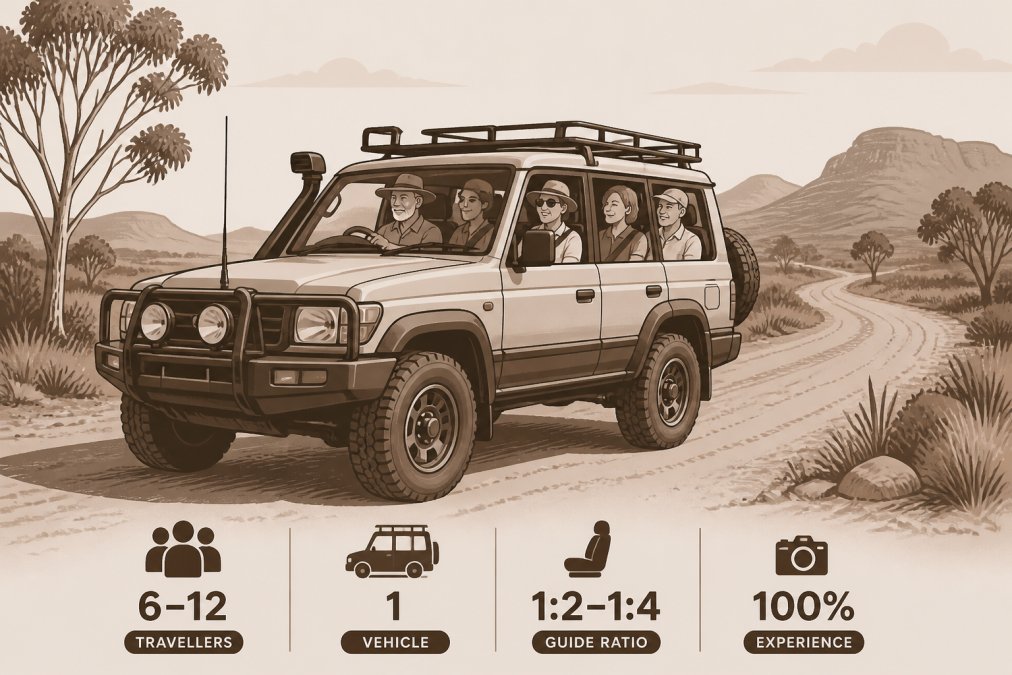
With fewer people, your guide monitors conditions more closely, ensures everyone has appropriate gear, and responds quickly if someone needs support. Purpose-designed 4WD vehicles beat crowded coaches for both comfort and terrain capability. When you're customizing, you see exactly where your money goes, you're not subsidizing empty seats or paying for activities you'll skip.
Key Features That Define a Quality Private Group Experience
Expert Local Guides and Storytelling
Your guide isn't just navigating you from point A to point B, they're the difference between seeing a landscape and understanding it. A quality guide knows the history, geology, cultural significance, and stories that make a place meaningful. They know where tourists don't go and why locals value certain locations.
For mature travellers especially, this storytelling element matters. You're sitting with a guide who can explain why a particular rock formation matters or what a community's connection to the land actually means. Guides should have verifiable credentials for safety in remote areas: first aid training, navigation skills, and genuine experience in the terrain you're covering. Before committing to any operator, ask directly about guide qualifications and insurance coverage.
Flexible Itinerary Customization
True customization means your group defines core interests, cultural immersion, natural landscape, adventure activities, or relaxation, and the operator builds the itinerary around those priorities. It means the guide can pivot if weather changes, if your group discovers something unexpected, or if energy levels shift.
Ask potential operators how much flexibility they actually allow. Can you add an extra day somewhere? Skip an activity? Extend time in a location? The answers reveal whether customization is genuine or superficial.
Group Size and Intimate Atmospheres
There's a sweet spot for small group size: typically between 6 and 12 people. Smaller than 6, and you're paying premium prices for limited economies of scale. Larger than 12, and the group dynamic shifts, making it harder for everyone to feel heard. Quality operators think carefully about group composition, not just numbers.
How to Plan a Private Group Holiday: Step-by-Step
Planning a customizable private tour requires more deliberation than booking a fixed departure, but the investment pays off.

Define Your Group's Interests and Pace
Before contacting any operator, get clear on what your group actually wants. Start by asking: Are you seeking cultural immersion, natural landscape exploration, adventure activities, relaxation, or a mix? How physically demanding should the itinerary be? What's the ideal pace, active days with early starts, or slower mornings and flexible afternoons? Do you want accommodation in remote locations or more comfort-focused options?
Document this as a brief group profile. Operators who push back on your preferences or try to reshape them into their standard offering are signalling that customization isn't their strength.
Set Your Budget and Timeline
Customizable private tours don't have fixed pricing because they're genuinely custom. Discuss with your group: What's the total budget? Are you comfortable with premium accommodation in remote areas, or would you prefer mid-range options? How much should go toward guide expertise versus logistics?
Timeline matters equally. How many days can your group commit? Are you flexible on dates, or do you need specific windows? Operators often offer better value for flexible dates because they can optimize logistics.
Create a Detailed Brief for Your Operator
Once you've clarified your group's vision and constraints, create a brief document for potential operators. Include:
- Group size and composition (ages, mobility considerations, experience level)
- Destination preferences and must-see locations
- Interests and activities to prioritize
- Pace preference (active, relaxed, mixed)
- Accommodation standards and specific requirements
- Budget range (total and per person)
- Desired travel dates or flexibility window
- Logistical constraints (dietary requirements, accessibility needs, language preferences)
This brief reveals which operators take customization seriously. Operators who respond with generic itineraries haven't read your brief.
Review, Refine, and Confirm
When operators send proposals, examine how closely they match your stated interests, whether pacing and activity levels are realistic, and if the guide assignment is clear. Ask clarifying questions about flexibility, what happens if weather changes, and how costs are itemized. Red flags include vague answers, pressure to decide quickly, or reluctance to discuss specifics.
Once you've selected an operator, maintain communication as the tour approaches. Share any updates about group composition, mobility needs, or interest shifts.
Cost of Private Guided Tours: What to Expect
Pricing for customizable private tours varies because the product itself varies. Cost drivers include group size (a 6-person tour spreads costs over fewer people than a 12-person group), destination remoteness, accommodation standards, and specialist guides.
Customization itself has a cost. Designing a bespoke itinerary requires operator time, research, and coordination. Quality operators provide detailed cost breakdowns showing guide fees, vehicle costs, accommodation, meals, activities, and logistics. They explain what's included and what's not.
For groups, shared costs often create surprising value. A private tour split among 10 people can sometimes cost less per person than a standard group tour while delivering significantly more customization and comfort.
Customizable Private Tours vs. Fixed Group Departures
Fixed group departures operate on set dates with pre-designed itineraries. The advantage is simplicity and often lower per-person cost. The disadvantage is inflexibility, if the itinerary doesn't match your interests perfectly or your group's pace differs, you're managing misalignment.
Customizable private tours start with your group's vision and build the itinerary around it. You control dates, pace, activities, and focus. The trade-off is that you need to invest time in planning and typically pay more per person because you're not sharing costs across multiple departure groups.
| Aspect | Fixed Group Departures | Customizable Private Tours |
|---|---|---|
| Itinerary Design | Pre-set, non-negotiable | Built around your group's interests |
| Dates | Fixed departure schedule | Your preferred dates (within availability) |
| Group Composition | Mixed strangers | Your existing group or curated by operator |
| Pace | Standard for all participants | Adjusted to your group's comfort level |
| Cost Per Person | Lower (shared across multiple groups) | Higher (costs split among your group only) |
| Flexibility During Tour | Limited | High (guide can pivot based on conditions) |
| Planning Effort | Minimal | Moderate (requires upfront coordination) |
| Best For | Budget-conscious, flexible travellers | Groups with specific interests and pace needs |
Sustainability and Ethical Considerations in Private Group Travel
Small group travel, when done thoughtfully, has a lighter environmental and cultural footprint than mass tourism. But "small" doesn't automatically mean sustainable.
Environmental considerations matter in remote areas especially. Quality operators manage impact through established routes that minimize damage, adherence to environmental regulations, and education about Leave No Trace principles. Ask operators: How do you manage waste? What's your vehicle maintenance and fuel strategy? Do you support local conservation initiatives? Are there seasonal restrictions you observe to protect wildlife or vegetation?
Cultural ethics are equally important. Quality operators have relationships with communities, understand cultural protocols, and ensure tourism benefits locals rather than exploiting them. This means guides come from local communities, tour fees support local businesses, there are protocols for photographing cultural sites, and interactions are reciprocal.
For your group, this translates to practical choices. Where you eat, stay, and shop matters. Choosing locally-owned accommodation and restaurants directs money to communities. Respecting photography restrictions and cultural protocols shows respect. Being genuinely curious rather than performatively interested changes how communities experience tourism.
Customizable private tours for small groups solve a real problem: they let you travel the way you actually want to travel, not the way the tourism industry assumes you should. For mature travellers, social groups, and anyone who values comfort, authenticity, and genuine connection over rushing through checkpoints, they're worth the planning effort.
Curious Compass Collective has built an entire approach around this principle, small groups, thoughtfully paced itineraries, expert guides who tell stories rather than just point out landmarks, and the flexibility to adjust when something unexpected captures your attention. Start by clarifying what your group actually wants from travel, then find an operator who listens carefully and designs accordingly.
Frequently Asked Questions
What's the real difference between a customizable private tour and a scheduled small group departure?
Customizable private tours let your group set the pace, choose activities, and adjust the itinerary on the fly. Scheduled departures run fixed routes with fixed dates and activities. Private tours cost more per person but offer exclusive access, flexible timing, and experiences tailored to your group's interests. Scheduled departures are more affordable but sacrifice flexibility and personalization for efficiency.
How far in advance should we book a customizable private tour for a small group?
Most operators recommend booking 8-12 weeks ahead for domestic tours and 12-16 weeks for Pacific destinations. This allows time for detailed itinerary planning, guide allocation, and logistics coordination. Last-minute bookings (4-6 weeks) are sometimes possible but may limit customization options and increase costs. Early booking also gives you more control over dates and guide selection.
Are private tours really more expensive than group packages, and how do I budget?
Private tours cost more per person than fixed group departures because you're paying for exclusivity, flexibility, and dedicated resources. However, costs depend on group size, destination, duration, and customization level. Larger groups (8-12 people) spread fixed costs like vehicle hire and guide fees, reducing per-person expense. Always request a detailed quote that breaks down transport, accommodation, activities, and guide fees to compare fairly.
What should I include in a brief when requesting a custom tour itinerary?
Include group size and age range, travel dates and duration, destination preferences, interests (cultural, adventure, culinary, scenic), physical activity level, budget range, any dietary or accessibility requirements, and must-see or must-avoid activities. Mention whether you want flexibility to change plans mid-tour. The more detail you provide, the better the operator can tailor the experience and avoid costly revisions later.
What level of flexibility can I expect from a tailor-made tour operator?
Top operators build flexibility into every itinerary. You can typically extend stays at favourite locations, swap activities, adjust daily start times, and add spontaneous detours. Some changes incur small fees if they affect guide availability or accommodation. Confirm flexibility terms upfront, ask whether you can modify the itinerary during the tour without penalty, and which decisions require advance notice.
How do customizable private tours ensure authentic local experiences rather than packaged tourist activities?
Quality operators employ local guides with deep community connections, visit lesser-known sites off standard tourist routes, and include unscheduled time for spontaneous interactions. They partner with local businesses and cultural custodians rather than relying on mainstream attractions. Ask prospective operators about their relationships with local communities, whether guides are from the region, and how they balance accessibility with authenticity.
This article was written using GrandRanker
Frequently Asked Questions
What's the real difference between a customizable private tour and a scheduled small group departure?
Customizable private tours let your group set the pace, choose activities, and adjust the itinerary on the fly. Scheduled departures run fixed routes with fixed dates and activities. Private tours cost more per person but offer exclusive access, flexible timing, and experiences tailored to your group's interests. Scheduled departures are more affordable but sacrifice flexibility and personalization for efficiency.
How far in advance should we book a customizable private tour for a small group?
Most operators recommend booking 8–12 weeks ahead for domestic tours and 12–16 weeks for Pacific destinations. This allows time for detailed itinerary planning, guide allocation, and logistics coordination. Last-minute bookings (4–6 weeks) are sometimes possible but may limit customization options and increase costs. Early booking also gives you more control over dates and guide selection.
Are private tours really more expensive than group packages, and how do I budget?
Private tours cost more per person than fixed group departures because you're paying for exclusivity, flexibility, and dedicated resources. However, costs depend on group size, destination, duration, and customization level. Larger groups (8–12 people) spread fixed costs like vehicle hire and guide fees, reducing per-person expense. Always request a detailed quote that breaks down transport, accommodation, activities, and guide fees to compare fairly.
What should I include in a brief when requesting a custom tour itinerary?
Include group size and age range, travel dates and duration, destination preferences, interests (cultural, adventure, culinary, scenic), physical activity level, budget range, any dietary or accessibility requirements, and must-see or must-avoid activities. Mention whether you want flexibility to change plans mid-tour. The more detail you provide, the better the operator can tailor the experience and avoid costly revisions later.
What level of flexibility can I expect from a tailor-made tour operator?
Top operators build flexibility into every itinerary. You can typically extend stays at favourite locations, swap activities, adjust daily start times, and add spontaneous detours. Some changes incur small fees if they affect guide availability or accommodation. Confirm flexibility terms upfront—ask whether you can modify the itinerary during the tour without penalty, and which decisions require advance notice.
How do customizable private tours ensure authentic local experiences rather than packaged tourist activities?
Quality operators employ local guides with deep community connections, visit lesser-known sites off standard tourist routes, and include unscheduled time for spontaneous interactions. They partner with local businesses and cultural custodians rather than relying on mainstream attractions. Ask prospective operators about their relationships with local communities, whether guides are from the region, and how they balance accessibility with authenticity.