 ultimate-guide
Bungle Bungles Tours: The 2026 Planning Guide
Table of Contents
- What Bungle Bungles Tours Actually Involve
- Purnululu National Park Access: 4WD Tracks, Permits and Flights In
- Best Time to Visit the Bungle Bungles
- Bungle Bungle Scenic Flights: What You See From the Air
- Walking Highlights: Cathedral Gorge, Echidna Chasm and Piccaninny Creek
- Camping, Accommodated Stays and Tour Packages
- DIY Trip vs Guided Bungle Bungles Tours: What Suits Mature Travellers
- Photography, Accessibility and Low-Impact Visiting
- Frequently Asked Questions
Last Updated: September 14, 2026
What Bungle Bungles Tours Actually Involve
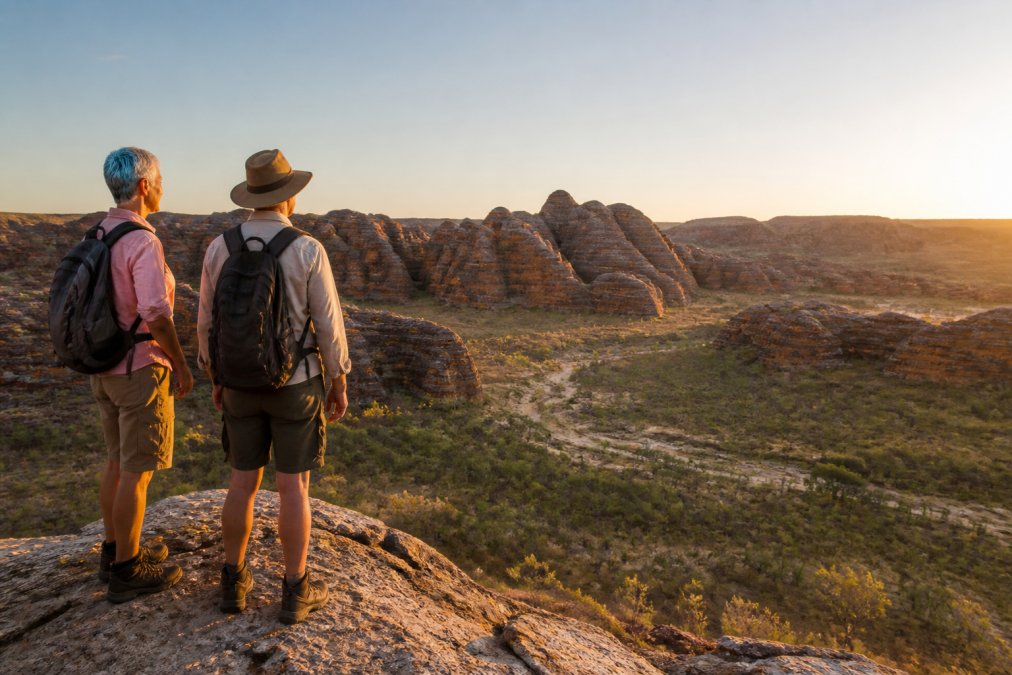
Bungle Bungles tours are guided or self-driven visits to the striped sandstone domes of Purnululu National Park, and they come in two distinct forms: ground tours that travel the Spring Creek Track into the park, and scenic flights that view the formations from above. Bungle Bungles tours are guided or self-driven visits to the striped sandstone domes of Purnululu National Park, and they come in two distinct forms: ground tours that travel the Spring Creek Track into the park, and scenic flights that view the formations from above. The choice between them shapes everything else about your trip.
The park sits in the Kimberley region of Western Australia, roughly 250 kilometres south of Kununurra. It became a World Heritage site in 2003 for its geological and cultural values, and the orange and black banding on the domes comes from alternating layers of sandstone and cyanobacteria.
Ground tours put you inside Cathedral Gorge and Echidna Chasm. Scenic flights cover the scale of the massif in under two hours.
Below, we break down access, timing, costs and the practical differences between DIY and guided options.
Ground Tours vs Scenic Flights: How to Choose
Ground tours suit travellers who want to walk the trails, stand under the gorge walls and spend a night or two inside the park. Scenic flights suit anyone short on time, or anyone unwilling to tackle a rough 4WD track.
The trade-off is simple. Ground access delivers the close-up experience but demands a high-clearance 4WD, about 90 minutes of slow driving from the highway, and a tolerance for corrugations. Flights skip all of that and show you the beehive formations, Piccaninny Creek's winding bed and the hidden gorges in one sweep.
Many visitors do both. A flight on arrival day, then a ground tour the next morning, gives you the aerial context and the on-foot detail.
Purnululu National Park Access: 4WD Tracks, Permits and Flights In
Access to Purnululu National Park is by the Spring Creek Track, a 53-kilometre unsealed road off the Great Northern Highway, or by air from Kununurra, Halls Creek or Warmun. The track is suitable only for high-clearance 4WD vehicles, and it typically takes 90 minutes to two hours each way.
Caravans, camper trailers and conventional cars should not attempt it. The track crosses creek beds, has steep sections and is often closed after rain.
Every vehicle entering the park needs a park entry permit, payable at the visitor centre or online through the Parks and Wildlife Service WA. Camping requires a separate fee and a pre-booked site during peak season.
Scenic flights depart from Kununurra and Halls Creek, with some operators offering pickups from Warmun. Private charter is the most flexible option for small groups.
Best Time to Visit the Bungle Bungles
The best time to visit the Bungle Bungles is the dry season, from April to September, when the Spring Creek Track is open and daytime temperatures sit in the high twenties to low thirties. The park closes to visitors during the wet season, typically from October or November through to March or April, depending on rainfall.
Peak months are June, July and August. Expect busy campgrounds, higher flight prices and booked-out guided departures. May and September offer the same open access with fewer crowds and cooler mornings.
Daytime heat in the shoulder months can still climb, so plan walks for early morning. Carry at least three litres of water per person for any gorge walk, and more if you are heading to Piccaninny Creek.
Bungle Bungle Scenic Flights: What You See From the Air
A Bungle Bungle scenic flight covers the full extent of the massif in roughly one to two hours, depending on departure point and aircraft. From the air you see the striped domes in their thousands, the deep incision of Echidna Chasm, the amphitheatre of Cathedral Gorge and the dry braided bed of Piccaninny Creek.
Flights from Kununurra run about two hours and cross the Ord River irrigation area and Lake Argyle on the way. Flights from Halls Creek are shorter, around one hour, and focus purely on the park.
Fixed-wing aircraft give a higher, wider view. Helicopters fly lower and can hover over specific formations, which matters if photography is your priority.
| Flight Option | Typical Duration | Departure Point | Best For |
|---|---|---|---|
| Fixed-wing scenic | 1-2 hours | Kununurra or Halls Creek | Wide views, lower cost |
| Helicopter scenic | 30-60 minutes | Park airstrip or Warmun | Close-up photography |
| Private charter | Flexible | Custom | Small groups, custom routing |
Walking Highlights: Cathedral Gorge, Echidna Chasm and Piccaninny Creek
The three signature walks inside the park are Cathedral Gorge, Echidna Chasm and the Piccaninny Creek lookout. Each is short, but the terrain is uneven and the heat is real, so pace matters more than distance.
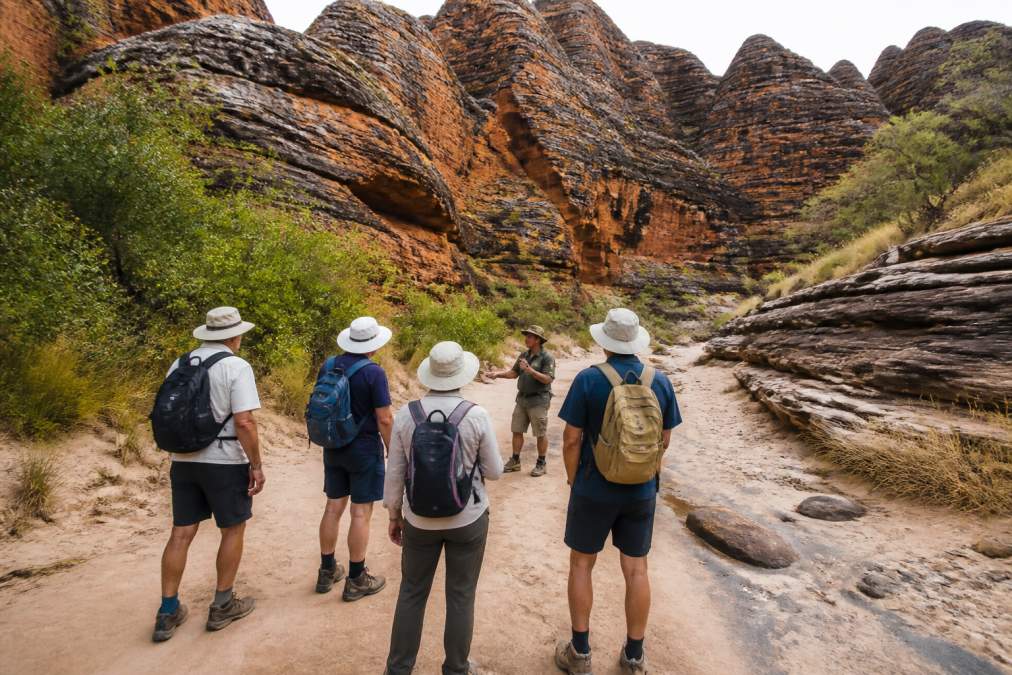
Cathedral Gorge is a one-kilometre return walk from the southern car park, finishing in a natural amphitheatre with a shallow pool at its base. The acoustics are extraordinary, and most guided groups pause here for a while.
Echidna Chasm sits at the northern end and is a two-kilometre return walk through a narrow cleft in the range. The final section involves scrambling over boulders, and the chasm is best visited around midday when light shafts reach the floor.
Piccaninny Creek is a dry watercourse that doubles as a walking route. The lookout is an easy walk; continuing upstream toward the domes is a longer, unmarked proposition that should only be attempted with a guide or solid navigation.
Camping, Accommodated Stays and Tour Packages
Overnight options inside Purnululu are limited to two campgrounds: Walardi and Kurrajong. Both are basic, with pit toilets and no power or water. Sites must be booked in advance during the dry season.
Accommodated stays sit outside the park. Warmun and Halls Creek have roadhouse-style rooms, and Kununurra offers the widest range of hotels, resorts and caravan parks. Accommodated stays sit outside the park. Warmun and Halls Creek have roadhouse-style rooms, and Kununurra offers the widest range of hotels, resorts and caravan parks.
Because pricing depends on group size, season and aircraft type, it is worth requesting a current quote rather than relying on older figures you find online.
DIY Trip vs Guided Bungle Bungles Tours: What Suits Mature Travellers
Guided Bungle Bungles tours remove the two hardest parts of a DIY trip: the Spring Creek Track and the heat. If you are travelling with a group, managing a rough 4WD track, navigation and water logistics on top of that is genuinely tiring. But the DIY-versus-guided decision is really a question of what you are paying for, and it helps to see the moving parts side by side.
What a DIY trip actually requires
A self-drive visit is not simply a matter of owning a 4WD. The Spring Creek Track is 53 kilometres of unsealed road with creek crossings, steep sections and heavy corrugations, and it is only suitable for high-clearance 4WD vehicles. Caravans, camper trailers and conventional cars should not attempt it. You will also need:
- A park entry permit for every vehicle, payable at the visitor centre or online through the Parks and Wildlife Service WA
- A pre-booked campsite at Walardi or Kurrajong if you intend to stay overnight, with separate camping fees
- Enough fuel, water and food for the round trip, since there are no supplies inside the park
- A realistic tolerance for corrugations, dust and limited roadside assistance
On paper, DIY looks cheaper because you are not paying a guide. In practice, the costs sit in vehicle preparation, fuel, permits, camping fees and the time the track consumes. A 90-minute to two-hour drive each way, on a rough surface, is a full half-day before you have walked anywhere.
What a guided tour bundles
Guided packages typically combine ground transfers, park entry, a guided walk and sometimes meals into a single price. Because pricing depends on group size, season and aircraft type, it is worth requesting a current quote rather than relying on older figures you find online. The value is not just convenience: a guide handles the track, sets a pace for the group rather than the fittest member, and carries the local knowledge of the geology, the cultural stories and the safest routes.
How to choose
DIY works if you have a suitable high-clearance 4WD, are comfortable with remote driving and want full control of your schedule. Guided works if you want the track handled, a guide who knows the country, and an itinerary that bends to what the group actually wants to do. For clubs and social groups, a private tour is often the middle path: the flexibility of DIY with the logistics removed.
Curious Compass Collective runs small-group Kimberley trips built around exactly this: purpose-designed 4WD vehicles, guides who tell the story of the country, and itineraries paced for travellers who want to see it properly rather than tick it off.
Photography, Accessibility and Low-Impact Visiting
This is where most Bungle Bungles guides stop short, so it is worth going deeper. Photography, accessibility and low-impact visiting each reward specific knowledge, and the accessibility detail in particular is something few operators spell out.
Photography: timing beats equipment
The domes glow in the first and last two hours of daylight, when the low sun angle throws the orange and black banding into deep relief. Midday light flattens the formations, so plan your ground walks for early morning or late afternoon where you can. The exception is Echidna Chasm, where the light shafts reach the floor around midday and the narrow cleft is at its most dramatic.
A polarising filter helps cut haze on scenic flights, and a lens in the 24-70mm range covers most ground compositions. If you are flying, ask the operator about window seats and whether the aircraft allows open windows or photography windows, since this varies by aircraft type.
Accessibility: the honest picture
Accessibility is the real limitation at Purnululu, and it deserves a straight answer rather than a vague one. The Spring Creek Track is rough and unsealed, the gorge walks are uneven and unsealed, and there is no wheelchair-accessible trail inside the park. The Cathedral Gorge and Echidna Chasm walks both involve sand, rock and, in Echidna Chasm, scrambling over boulders.
For travellers with mobility limitations, the scenic flight is the most practical way to experience the full spectacle. It delivers the scale of the massif, the striped domes and the hidden gorges without leaving the aircraft, and it avoids the track entirely. If you use a wheelchair or have limited mobility, confirm with operators in advance what boarding assistance is available, since aircraft types differ and not all are equally accessible. A private charter can also be arranged to suit specific needs, though it costs more.
Low-impact visiting
Low-impact visiting is straightforward but important, because the sandstone structures are fragile and the park is jointly managed with Traditional Owners. Stay on marked trails, carry out everything you bring in, do not touch or climb the domes, and respect cultural sites. The rock art and burial sites are protected, and climbing or touching the domes causes irreversible damage. Leave No Trace principles apply throughout: plan ahead, dispose of waste properly, and leave what you find.
For current park conditions, closures and permit details, check the Parks and Wildlife Service park page before you travel, and confirm flight and tour availability directly with operators, since seasonal schedules shift.
Frequently Asked Questions
How much do Bungle Bungles tours cost?
Pricing depends on the operator, trip length, whether you fly or drive in, and whether camping or accommodated stays are included. Scenic flights, guided ground tours and multi-day packages all sit at different price points, and seasonal demand shifts rates too. Rather than quote a figure that will be out of date next season, check current pricing directly with the operator you are considering and ask what the fee covers: park entry, meals, guiding and transfers vary between packages.
How long do you need to see the Bungle Bungles?
A scenic flight gives you the striped domes in a couple of hours, but a ground visit needs more. Most travellers allow two to three nights inside the park to walk Cathedral Gorge, Echidna Chasm and the Piccaninny Creek lookout at an unhurried pace. Add a night on either side for the drive in and out, since the access track is slow and corrugated. Guided Bungle Bungles tours usually build this pacing in so nobody is rushed between sites.
What is the best time of year to visit Purnululu National Park?
The dry season runs roughly from April to September, and that is when the park is open and the access track is passable. July and August bring the most reliable weather and the busiest conditions. May, June and September are quieter and still comfortable. The park closes during the wet season because creeks flood and the road becomes unsafe, so plan around the dry months and confirm opening dates before you book anything.
Are Bungle Bungles tours suitable for mature travellers?
Yes, provided you pick the right format. Scenic flights involve no walking at all, and guided ground tours can be paced around shorter walks on uneven but manageable terrain. Cathedral Gorge is the easiest of the main walks; Echidna Chasm involves rocky ground and some uneven steps. Small-group operators with purpose-designed 4WD vehicles and guides who set a steady pace make the park far more accessible than self-driving the corrugated access track.
Planning a remote outback trip asks a lot of you: the track, the heat, the logistics and the timing all have to line up. Curious Compass Collective handles those details with purpose-designed 4WD vehicles, expert guides who double as storytellers, and small-group itineraries paced for mature travellers rather than rushed through. If you want the Kimberley without the strain, view our tours and let us build the trip around your group.