 listicle
Best Pacific Island Cultural Experiences 2026
Table of Contents
- What Makes a Pacific Cultural Experience Authentic?
- The Best Pacific Island Cultural Experiences for 2026
- Etiquette for Visiting Pacific Island Villages
- How to Prepare for Pacific Island Cultural Workshops
- Why Choose Small Group Cultural Tours Pacific
- 2026 Cultural Festivals and Events Calendar
- Sustainable Tourism: Supporting Local Communities
- Frequently Asked Questions
Last Updated: September 5, 2026
Travellers seeking meaningful connection rather than a resort tan are rethinking how they explore the South Pacific. Authentic pacific island cultural experiences go far beyond staged floor shows and hotel lobbies; they involve sitting with elders, learning customary protocols, and understanding living heritage that has survived for centuries. At Curious Compass Collective, we design small-group journeys for mature travellers who want depth without discomfort, and we have learned that the best pacific island cultural experiences 2026 has to offer are those rooted in respect and genuine exchange.
The quality of your cultural immersion depends less on the destination than on how you arrive. A thoughtful guide who introduces you properly to a village chief changes everything. Below, we break down the standout cultural experiences for 2026, the etiquette rules that keep doors open, and how to prepare for workshops so you leave as a guest who was welcomed back, not a tourist who was tolerated.
What Makes a Pacific Cultural Experience Authentic?
Authenticity in Pacific travel is the degree to which an experience is led by local people, follows their customary protocols, and happens on their terms rather than for a camera. A genuine village visit involves a sevusevu ceremony, a shared meal, and conversation, not a fifteen-minute photo stop.
The Pacific spans two broad cultural spheres that travellers often confuse. Polynesian culture, found in Samoa, Tonga, and parts of Fiji, centres on chiefly systems, oratory, and fine mat weaving. Melanesian heritage, dominant in Vanuatu and the western islands of Fiji, is rooted in village longhouses, graded societies, and land-based ancestral traditions.
These distinctions matter deeply to local people. Offering a Fijian-style kava ceremony in a Vanuatu village signals that you have not done your homework. A skilled operator matches the experience to the specific indigenous customs of each island group, which is precisely where the pacific island cultural experiences recommended in this guide differ from generic itineraries.
The Best Pacific Island Cultural Experiences for 2026
Curious Compass Collective offers thoughtfully paced itineraries designed specifically for mature travellers who want authentic engagement without physical strain. We keep groups intentionally small, cap the pace at a relaxed rhythm, and employ expert guides who act as storytellers and cultural bridges, not just drivers.
A common approach among larger operators is to treat culture as a half-day add-on to a beach holiday. We treat it as the centrepiece. Our nine-day Fiji journey, for example, lets you split your stay between 4 and 5 star hotels and a traditional village stay, giving you comfort when you need it and immersion when you want it.
Fiji: Village Stays and the Blue Lagoon Region
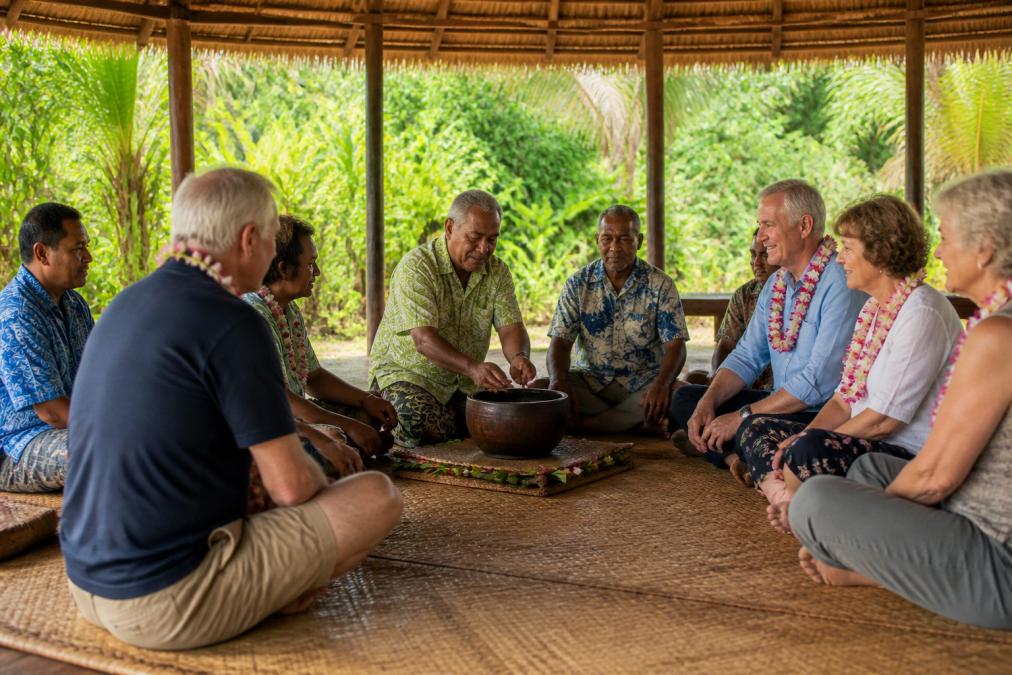
Fiji offers the most accessible entry point into Polynesian-influenced village life, particularly in the remote Blue Lagoon region. Here you can visit the actual caves featured in the 1980 film The Blue Lagoon and the island where Tom Hanks was stranded in Castaway, all while staying in communities that still practise customary protocols.
The highlight for many travellers is the traditional village stay, where you sleep in a simple bure, share meals with a host family, and join morning church services if you wish. The Bula spirit is genuine, but it flows both ways: villagers welcome you warmly when you respect their sevusevu protocol, which means presenting kava root to the chief upon arrival.
Vanuatu: Customary Practices and Volcanic Landscapes
Vanuatu delivers the most raw and unmediated Melanesian heritage in the Pacific. The island of Tanna is home to both the active Mount Yasur volcano and villages where customary practices, including land diving on Pentecost Island, remain central to daily life (volcano.si.edu). Cultural performances here are not staged for tourists; they are rehearsals for genuine ceremonies you are permitted to observe.
What makes Vanuatu challenging is logistics. Inter-island travel relies on small aircraft and irregular boat schedules, which is why most independent travellers miss the deeper experiences. This is where small group cultural tours pacific operators earn their keep, handling the connections so you can focus on the moment rather than the schedule.
Samoa: Traditional Feasts and Fine Mats
Samoa offers the most intact Polynesian culture in the Pacific, built around the matai chiefly system and the 'ava ceremony. The island's signature cultural experience is the traditional feast, or to'ona'i, where you eat with your hands from woven platters while listening to oratory. Fine mat weaving, or 'ie toga, remains a living art form, and skilled weavers are happy to explain the social significance of each pattern.
The Sunday church service is a cultural experience in itself. Samoan choirs are renowned across the Pacific, and visitors are welcomed to attend, provided they dress modestly and arrive early. Ask your guide to arrange a visit to a village weaver or a tattoo artist practising the traditional pe'a, and you will leave with a far richer understanding of ancestral traditions than any museum could offer.
Etiquette for Visiting Pacific Island Villages
Etiquette for visiting Pacific Island villages is straightforward but non-negotiable, and getting it wrong can end your visit before it begins. The core rule is to treat the village as someone's home, not an attraction.
Follow these guidelines on every visit:
- Present sevusevu (kava root) to the chief upon arrival, and wait to be invited to speak.
- Dress modestly: shoulders and knees covered, especially for women.
- Remove hats and sunglasses when entering a village or meeting elders.
- Ask permission before photographing people, particularly during ceremonies.
- Sit cross-legged or with legs tucked if seated on mats, never point your feet at people or food.
- Accept the kava bowl with both hands and drink it in one go if you can.
A common mistake is assuming these rules are flexible for paying guests. They are not. Villages that feel disrespected have every right to refuse entry, and word travels quickly between communities. Respecting customary practices is the difference between a superficial stop and an invitation to return.
How to Prepare for Pacific Island Cultural Workshops
Knowing how to prepare for Pacific Island cultural workshops ensures you get the most from hands-on sessions like tapa cloth printing, coconut husking, or traditional cooking. Preparation is mostly practical: bring modest clothing, a small gift for your host family, and an open mind.
Most workshops require physical participation, so pace yourself. If you have limited mobility, tell your guide in advance. Skilled operators adjust activities so you can observe and assist from a seated position rather than missing out entirely. A good workshop leader will also brief you on what will happen, so you never feel caught off guard.
Why Choose Small Group Cultural Tours Pacific
Small group cultural tours Pacific operators offer a superior experience for mature travellers because they can access communities that turn away large tour buses, while providing the safety and comfort that independent travel in remote islands cannot guarantee. Group size matters: a dozen travellers can share a village meal, but forty cannot.
Curious Compass Collective keeps groups intentionally small and paces itineraries so you are never exhausted by day three. Our guides are qualified safety professionals as well as storytellers, and our purpose-designed 4WD vehicles handle island terrain while you enjoy the view. We also accommodate travellers with mobility concerns, ensuring you can participate from a comfortable position rather than being confined to the vehicle.
What most reviews miss is the difference between a tour company and a cultural broker. The best operators have long-standing relationships with specific villages, built over years of respectful visits. They know which families welcome guests, which days suit ceremonial visits, and how to adjust plans when a village has its own priorities. That local knowledge transforms a trip from sightseeing into genuine cultural immersion.
2026 Cultural Festivals and Events Calendar
Planning your 2026 travel around a cultural festival adds structure and depth to your journey. These events are the living heritage of the Pacific, where customary practices are performed with pride and purpose. While many guides list festivals without dates, we have compiled the most reliable 2026 windows based on customary calendars and historical patterns. Always confirm exact dates with your operator or the national tourism office, as Pacific festivals often shift according to local calendars, moon phases, and weather.
| Festival | Location | 2026 Timing (Expected) | What to Expect | Booking Note |
|---|---|---|---|---|
| Hibiscus Festival | Suva, Fiji | 8-16 August | Parades, traditional dance, crafts, crowning of the festival queen | Book Suva accommodation 6 months ahead; it is the nation's largest public event |
| Bula Festival | Nadi, Fiji | Mid-July (typically 12-19) | Cultural performances, food stalls, community concerts | A more local alternative to Hibiscus with fewer international crowds |
| Festival of Pacific Arts | Rotating host (2026 host TBC) | Usually 2 weeks in June or July | Regional indigenous arts showcase with delegations from 27 nations | This is the single best event for cultural breadth; flights to the host nation sell out fast |
| Teuila Festival | Apia, Samoa | 1-7 September | Tattoo ceremonies, fine mat weaving, oratory, traditional tattooing demonstrations | Combine with a visit to the Samoa Cultural Village for hands-on workshops |
| Naghol Land Dive | Pentecost, Vanuatu | Saturdays from late April to early June | Ceremonial land diving from wooden towers; restricted viewing from designated platforms | Viewing is limited to certain Saturdays; book a local guide weeks in advance |
| Firewalking Ceremony | Beqa Island, Fiji | Weekly, but larger ceremonies during August | Walking over hot stones after a traditional yaqona ceremony | Only the Sawau tribe performs this; verify your operator has permission to attend |
A unique angle for 2026: the Festival of Pacific Arts is the region's premier rotating event, and its host nation for 2026 had not been confirmed at the time of writing. If it falls in a year you can travel, prioritise it, delegations from across the tropical archipelago gather for two weeks of dance, navigation, carving, and storytelling that you cannot see assembled anywhere else. For travellers who prefer quieter timing, the smaller village-level festivals in Fiji and Vanuatu offer a more intimate window into customary practice without the crowds.
Sustainable Tourism: Supporting Local Communities
Sustainable tourism in the Pacific is not an optional extra; it is the only model that keeps cultural experiences alive for future visitors. Community-based travel, where local people host, guide, and benefit financially, ensures that villages choose to share their heritage rather than abandon it for wage labour in towns. But sustainability in this region goes beyond carbon offsets and reusable water bottles, it is fundamentally about cultural sensitivity and the ethics of your behaviour inside a village.
Most guides tell you what to see; very few tell you how to behave in a way that leaves the community better off. Here is the ethical framework that separates a respectful visit from an extractive one:
Pay for access, not for performance. When a village hosts you for a ceremony or a meal, the customary expectation is a gift or a negotiated fee. Ask your operator what portion of your payment goes directly to the village. Reputable operators in Fiji and Vanuatu typically channel 60-80% of the cultural tour fee to the community fund, which pays for school supplies, clinic maintenance, or church repairs (responsibletravel.com). If an operator cannot or will not disclose this split, treat that as a red flag.
Buy with intention, not obligation. A practical way to support local communities is to buy directly from artisans at village markets rather than from resort gift shops. Handwoven baskets, tapa cloth, and carved wooden objects carry stories and skills that mass-produced souvenirs lack. Ask about the maker and the meaning of the patterns; artisans are usually delighted to explain. But be mindful of customary exchange systems, offering money for a ceremonial item can create awkward obligations. Instead, ask what the appropriate reciprocal gift would be, or purchase through a community-run cooperative where pricing is transparent.
Respect the 'no'. A village may decline to perform a ceremony, open a longhouse, or allow photography on a particular day. This is not a failure of hospitality; it is the community exercising its right to set terms. The most ethical response is to accept gracefully and adjust your plans. Villages that feel pressured by paying guests often close their doors to all future visitors, which harms the entire local tourism economy.
Leave no trace, culturally. Beyond physical litter, cultural litter includes disrespectful photos posted online, stories shared without permission, and assumptions that what you witnessed is 'primitive' or 'exotic'. Ask your guide what is appropriate to share on social media. In many Melanesian cultures, certain ceremonies are sacred and not meant for public broadcast. Honouring that boundary is a form of reciprocity that costs you nothing but builds immense goodwill.
The Pacific is not a theme park, and its cultures are not performances for your entertainment. They are living systems of kinship, land, and ancestral traditions that have survived colonisation, missionisation, and globalisation. The best way to honour them is to arrive with humility, leave with gratitude, and travel with operators who share that ethos.
Frequently Asked Questions
What are the most authentic cultural experiences in the Pacific Islands?
The most authentic experiences centre on village stays, customary ceremonies and hands-on workshops rather than resort performances. In Fiji, a traditional village stay with a kava ceremony offers genuine insight into daily life. Vanuatu's custom villages on Tanna Island preserve ancient practices, while Samoa's traditional tattoo and fine mat weaving sessions connect you directly with master artisans. Look for tours that include these elements and are led by local guides who act as cultural interpreters, not just drivers.
Are there small group cultural tours pacific travellers can book for 2026?
Yes, several operators run small group cultural tours across the Pacific for 2026. Curious Compass Collective offers a nine-day Fiji tour that includes a traditional village stay alongside resort accommodation, designed for mature travellers. Group sizes typically range from 8 to 15 people, which keeps experiences intimate and allows guides to personalise the pace.
What is the best time of year to visit the Pacific for cultural festivals?
The dry season from May to October is the most comfortable time to travel, and it aligns with several major cultural events. Fiji's Bula Festival runs in July, Vanuatu celebrates its independence on 30 July with traditional dancing, and Samoa's Teuila Festival takes place in September. These months offer lower humidity and less rain, making inter-island travel more reliable. Book early, as small group tours during festival periods fill quickly.
What should I pack for a cultural immersion trip to the Pacific Islands?
Pack light, breathable clothing that covers your shoulders and knees for village visits. A sulu or sarong is essential in Fiji and Samoa; it shows respect and is often required for church or village entry. Bring reef shoes for beach landings, a refillable water bottle, and modest swimwear. Gifts for village hosts, such as Australian macadamia nuts or quality tea, are appreciated. Leave valuables at home and carry a small daypack for workshops and market visits.
How can travellers support local communities during Pacific island tours?
Choose tours that employ local guides, stay in community-owned accommodation and eat at family-run restaurants. Buy crafts directly from artisans at local markets rather than airport shops. Respect customary practices, such as asking permission before taking photographs. Participate in village workshops where your fee goes straight to the community. Avoid tours that treat cultural sites as mere photo stops; instead, select experiences that prioritise meaningful exchange and heritage preservation.
This article was written using GrandRanker
Frequently Asked Questions
Q: What are the most authentic cultural experiences in the Pacific Islands?
A: The most authentic experiences centre on village stays, customary ceremonies and hands-on workshops rather than resort performances. In Fiji, a traditional village stay with a kava ceremony offers genuine insight into daily life. Vanuatu's custom villages on Tanna Island preserve ancient practices, while Samoa's traditional tattoo and fine mat weaving sessions connect you directly with master artisans. Look for tours that include these elements and are led by local guides who act as cultural interpreters, not just drivers.
Q: Are there small group cultural tours pacific travellers can book for 2026?
A: Yes, several operators run small group cultural tours across the Pacific for 2026. Curious Compass Collective offers a nine-day Fiji tour that includes a traditional village stay alongside resort accommodation, designed for mature travellers. Group sizes typically range from 8 to 15 people, which keeps experiences intimate and allows guides to personalise the pace.
Q: What is the best time of year to visit the Pacific for cultural festivals?
A: The dry season from May to October is the most comfortable time to travel, and it aligns with several major cultural events. Fiji's Bula Festival runs in July, Vanuatu celebrates its independence on 30 July with traditional dancing, and Samoa's Teuila Festival takes place in September. These months offer lower humidity and less rain, making inter-island travel more reliable. Book early, as small group tours during festival periods fill quickly.
Q: What should I pack for a cultural immersion trip to the Pacific Islands?
A: Pack light, breathable clothing that covers your shoulders and knees for village visits. A sulu or sarong is essential in Fiji and Samoa; it shows respect and is often required for church or village entry. Bring reef shoes for beach landings, a refillable water bottle, and modest swimwear. Gifts for village hosts, such as Australian macadamia nuts or quality tea, are appreciated. Leave valuables at home and carry a small daypack for workshops and market visits.
Q: How can travellers support local communities during Pacific island tours?
A: Choose tours that employ local guides, stay in community-owned accommodation and eat at family-run restaurants. Buy crafts directly from artisans at local markets rather than airport shops. Respect customary practices, such as asking permission before taking photographs. Participate in village workshops where your fee goes straight to the community. Avoid tours that treat cultural sites as mere photo stops; instead, select experiences that prioritise meaningful exchange and heritage preservation.